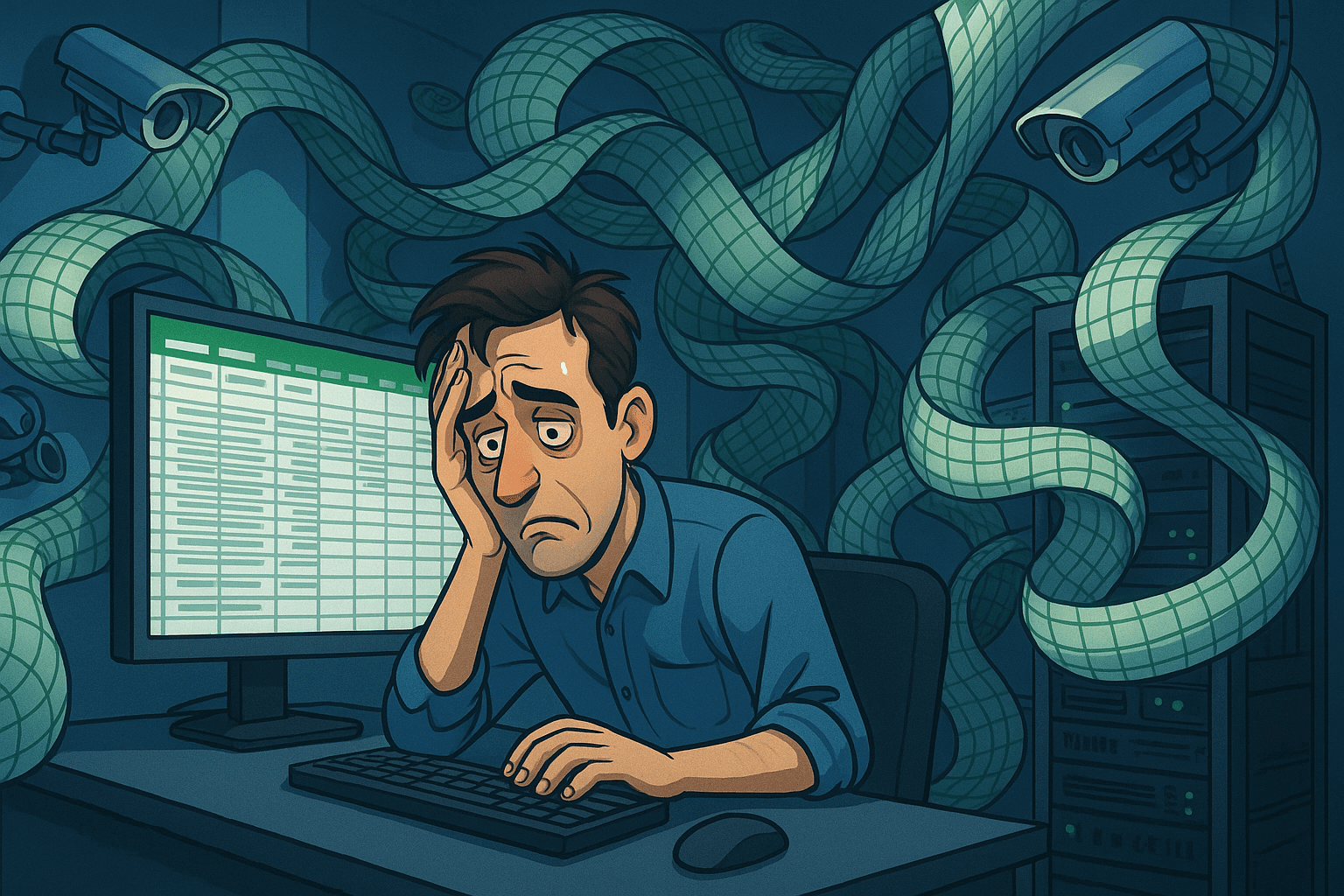
The shift to cloud security (VSaaS, ACaaS) is creating a hidden billing crisis for integrators. While 35% now report significant recurring revenue, most still manage subscriptions with spreadsheets and manual processes, leading to 1-5% annual margin erosion from billing errors, zombie subscriptions, and missed invoices. The integrators who treat billing infrastructure as seriously as technical capabilities will thrive; those clinging to project-era processes risk being left behind as manufacturers, MSPs, and smarter competitors move in.
Security integrators face an operational reckoning as the industry shifts from project-based hardware sales to recurring cloud subscriptions. While VSaaS and ACaaS markets are growing rapidly into a multi-billion dollar opportunity, integrators managing these subscriptions are hemorrhaging 1-5% of earnings annually to billing errors, zombie subscriptions, and manual reconciliation failures. The fundamental challenge: legacy back-office processes built for one-time project invoicing cannot scale to manage thousands of recurring micro-transactions across multiple vendor platforms.
According to Commercial Integrator's 2025 State of the Industry report, a combined 35% of integrator respondents said 21% or more of their revenue is now services-driven or subscription-based. Yet most integrators still rely on spreadsheets and manual processes that worked when recurring revenue meant alarm monitoring, not the complex matrix of per-camera storage tiers, per-door access fees, and usage-based analytics charges that cloud security demands.
The subscription explosion reshapes security economics
The cloud security market is undergoing a fundamental transformation. VSaaS and ACaaS are among the fastest-growing segments in physical security, with double-digit annual growth rates reshaping how integrators deliver and monetize their services.
The shift from one-time hardware sales to ongoing subscription relationships represents a sea change in business models across the industry. What's more, Genetec's 2024 State of Physical Security Report found that 74% of integrators anticipate more than half of their current customers will adopt cloud connectivity for security over the coming few years.
The business case for integrators is compelling: companies with strong recurring revenue streams typically command significantly higher valuations than those relying primarily on project-based work. More importantly, RMR creates predictable cash flow, deeper customer relationships, and a foundation for sustainable growth rather than the feast-or-famine cycle of project sales.
Multi-vendor chaos creates billing nightmares
The complexity emerges when integrators attempt to manage subscriptions across multiple vendors simultaneously. A typical mid-market integrator might resell services from Eagle Eye Networks for video, Brivo for access control, Genetec for unified security, and Alarm.com for monitoring, each with different billing cycles, discount structures, partner tiers, and portal interfaces.
Storage tier changes illustrate the billing complexity. When a customer increases video retention from 30 to 60 days mid-cycle, the integrator must calculate prorated charges, update their customer invoice, verify the vendor's next bill reflects the change correctly, and ensure the margin is preserved.
Multiply this by hundreds of customers making dozens of such changes monthly, and the administrative burden becomes untenable.
Margin erosion happens in spreadsheet shadows
The financial impact of billing failures is substantial and often invisible. MGI Research found that 42% of companies experience some form of revenue leakage. EY estimates businesses lose 1-5% of realized EBITA annually to these billing gaps. For a security integrator doing $5 million in annual revenue, that translates to $50,000-$250,000 in preventable losses.
John Nemerofsky, COO of SAGE Integration, in an interview in the Security Business magazine January 2024 issue, quantified a specific leak:
"As cameras or readers are installed, the integrator must turn on the service... yet, it may be another two weeks before the system is fully installed and the dealer is ready to begin invoicing the client. This may result in being billed by manufacturers, which in our case, could cost SAGE up to $30,000 or more per year."
The most insidious losses come from zombie subscriptions; services still being billed after customer cancellations or that aren't being actively used. For integrators managing subscriptions on behalf of customers, the problem compounds: they're paying vendors for services that customers canceled, or that are running on systems no longer in use. Annual billing cycles make these zombies particularly dangerous, as integrators may not catch the error until 12 months of charges have accumulated.
Common billing error sources include device count mismatches (vendor bills for cameras removed or not yet activated), storage overages from analytics features triggering additional consumption, timing discrepancies when activations process after billing cutoffs, and the simple data entry mistakes inevitable in spreadsheet-based workflows.
The industry prescribes better infrastructure
Industry experts converge on a clear recommendation: integrators must invest in purpose-built software to manage recurring revenue. The spreadsheet era has ended.
Gross margins on RMR business rose from 31.4% to 38.5% between 2022 and 2023, according to SSI's Recurring Revenue Deep Dive, indicating that proper management of recurring revenue is more profitable than traditional project work.
Brian Lohse, General Manager of Commercial at Alarm.com, identifies service bundling as the key tactical opportunity:
"In the SMB market, the big four RMR drivers are alarm monitoring, video surveillance as a service (VSaaS), access control as a service (ACaaS) and fire monitoring. Forward-looking partners package these as unified components of a single solution rather than separate offerings."
He recommends a novel KPI: "RMR per technician hour." Since most security companies are constrained by technician count and available hours, this metric "helps you make smart decisions as the landscape changes."
Conclusion: Billing infrastructure determines competitive survival
The transition to cloud security is irreversible. The 44% of end users with more than 25% of their physical security in cloud or hybrid-cloud environments (up from 24% in 2022, per Genetec) will only grow. SIA identifies several threats to traditional integrators who fail to adapt in the April 2024 issue of Security Business magazine: manufacturers building direct customer relationships, cloud solutions enabling vendors to offer managed services traditionally provided by integrators, and IT integrators/MSPs entering physical security.
Michael Hanlon, VP of Hosted/Managed Solutions at Allied Universal, frames the stakes plainly in an interview in Security Sales and Integrations:
"Resistance to change and fear of the unknown are real... But those reservations don't change the fact that our industry—in particular, vendors and end users—are clearly embracing services. And that means integrators could be left behind, losing out on work and valuable client relationships."
The integrators who thrive will be those who treat billing infrastructure with the same seriousness as technical capabilities.
The $30,000+ annual leakage documented by SAGE Integration
the 1-5% margin erosion identified by EY
and the one-third of SaaS spend wasted on zombie subscriptions
represent competitive disadvantage that compounds year over year. In a market growing at double-digit rates toward a massive combined opportunity, the cost of manual sales operations- and billing processes isn't just eating up margins. It's existential risk.
But, with the right infrastructure, integrators can stop the margin leakage, kill the zombie subscriptions, and turn recurring revenue into high-margin cash flow, without extra admin. Visit sharlic.com and book a demo today to learn how.
The shift to cloud security (VSaaS, ACaaS) is creating a hidden billing crisis for integrators. While 35% now report significant recurring revenue, most still manage subscriptions with spreadsheets and manual processes, leading to 1-5% annual margin erosion from billing errors, zombie subscriptions, and missed invoices. The integrators who treat billing infrastructure as seriously as technical capabilities will thrive; those clinging to project-era processes risk being left behind as manufacturers, MSPs, and smarter competitors move in.
Security integrators face an operational reckoning as the industry shifts from project-based hardware sales to recurring cloud subscriptions. While VSaaS and ACaaS markets are growing rapidly into a multi-billion dollar opportunity, integrators managing these subscriptions are hemorrhaging 1-5% of earnings annually to billing errors, zombie subscriptions, and manual reconciliation failures. The fundamental challenge: legacy back-office processes built for one-time project invoicing cannot scale to manage thousands of recurring micro-transactions across multiple vendor platforms.
According to Commercial Integrator's 2025 State of the Industry report, a combined 35% of integrator respondents said 21% or more of their revenue is now services-driven or subscription-based. Yet most integrators still rely on spreadsheets and manual processes that worked when recurring revenue meant alarm monitoring, not the complex matrix of per-camera storage tiers, per-door access fees, and usage-based analytics charges that cloud security demands.
The subscription explosion reshapes security economics
The cloud security market is undergoing a fundamental transformation. VSaaS and ACaaS are among the fastest-growing segments in physical security, with double-digit annual growth rates reshaping how integrators deliver and monetize their services.
The shift from one-time hardware sales to ongoing subscription relationships represents a sea change in business models across the industry. What's more, Genetec's 2024 State of Physical Security Report found that 74% of integrators anticipate more than half of their current customers will adopt cloud connectivity for security over the coming few years.
The business case for integrators is compelling: companies with strong recurring revenue streams typically command significantly higher valuations than those relying primarily on project-based work. More importantly, RMR creates predictable cash flow, deeper customer relationships, and a foundation for sustainable growth rather than the feast-or-famine cycle of project sales.
Multi-vendor chaos creates billing nightmares
The complexity emerges when integrators attempt to manage subscriptions across multiple vendors simultaneously. A typical mid-market integrator might resell services from Eagle Eye Networks for video, Brivo for access control, Genetec for unified security, and Alarm.com for monitoring, each with different billing cycles, discount structures, partner tiers, and portal interfaces.
Storage tier changes illustrate the billing complexity. When a customer increases video retention from 30 to 60 days mid-cycle, the integrator must calculate prorated charges, update their customer invoice, verify the vendor's next bill reflects the change correctly, and ensure the margin is preserved.
Multiply this by hundreds of customers making dozens of such changes monthly, and the administrative burden becomes untenable.
Margin erosion happens in spreadsheet shadows
The financial impact of billing failures is substantial and often invisible. MGI Research found that 42% of companies experience some form of revenue leakage. EY estimates businesses lose 1-5% of realized EBITA annually to these billing gaps. For a security integrator doing $5 million in annual revenue, that translates to $50,000-$250,000 in preventable losses.
John Nemerofsky, COO of SAGE Integration, in an interview in the Security Business magazine January 2024 issue, quantified a specific leak:
"As cameras or readers are installed, the integrator must turn on the service... yet, it may be another two weeks before the system is fully installed and the dealer is ready to begin invoicing the client. This may result in being billed by manufacturers, which in our case, could cost SAGE up to $30,000 or more per year."
The most insidious losses come from zombie subscriptions; services still being billed after customer cancellations or that aren't being actively used. For integrators managing subscriptions on behalf of customers, the problem compounds: they're paying vendors for services that customers canceled, or that are running on systems no longer in use. Annual billing cycles make these zombies particularly dangerous, as integrators may not catch the error until 12 months of charges have accumulated.
Common billing error sources include device count mismatches (vendor bills for cameras removed or not yet activated), storage overages from analytics features triggering additional consumption, timing discrepancies when activations process after billing cutoffs, and the simple data entry mistakes inevitable in spreadsheet-based workflows.
The industry prescribes better infrastructure
Industry experts converge on a clear recommendation: integrators must invest in purpose-built software to manage recurring revenue. The spreadsheet era has ended.
Gross margins on RMR business rose from 31.4% to 38.5% between 2022 and 2023, according to SSI's Recurring Revenue Deep Dive, indicating that proper management of recurring revenue is more profitable than traditional project work.
Brian Lohse, General Manager of Commercial at Alarm.com, identifies service bundling as the key tactical opportunity:
"In the SMB market, the big four RMR drivers are alarm monitoring, video surveillance as a service (VSaaS), access control as a service (ACaaS) and fire monitoring. Forward-looking partners package these as unified components of a single solution rather than separate offerings."
He recommends a novel KPI: "RMR per technician hour." Since most security companies are constrained by technician count and available hours, this metric "helps you make smart decisions as the landscape changes."
Conclusion: Billing infrastructure determines competitive survival
The transition to cloud security is irreversible. The 44% of end users with more than 25% of their physical security in cloud or hybrid-cloud environments (up from 24% in 2022, per Genetec) will only grow. SIA identifies several threats to traditional integrators who fail to adapt in the April 2024 issue of Security Business magazine: manufacturers building direct customer relationships, cloud solutions enabling vendors to offer managed services traditionally provided by integrators, and IT integrators/MSPs entering physical security.
Michael Hanlon, VP of Hosted/Managed Solutions at Allied Universal, frames the stakes plainly in an interview in Security Sales and Integrations:
"Resistance to change and fear of the unknown are real... But those reservations don't change the fact that our industry—in particular, vendors and end users—are clearly embracing services. And that means integrators could be left behind, losing out on work and valuable client relationships."
The integrators who thrive will be those who treat billing infrastructure with the same seriousness as technical capabilities.
The $30,000+ annual leakage documented by SAGE Integration
the 1-5% margin erosion identified by EY
and the one-third of SaaS spend wasted on zombie subscriptions
represent competitive disadvantage that compounds year over year. In a market growing at double-digit rates toward a massive combined opportunity, the cost of manual sales operations- and billing processes isn't just eating up margins. It's existential risk.
But, with the right infrastructure, integrators can stop the margin leakage, kill the zombie subscriptions, and turn recurring revenue into high-margin cash flow, without extra admin. Visit sharlic.com and book a demo today to learn how.
Subscribe to our newsletter
Subscribe to our newsletter
Subscribe to our newsletter